Etiquetas

24 junio, 2024

Hamony Mohammed

Current Club: Le Havre U-19 Date of Birth/Age/Place: 08/05/2006 (17), Casablanca, Morocco. Dual nationality: Morocco-France Career Path: AJ Jamila, Le Havre Position: Left Winger Height: 1.78 m Mohammed Hamony is a right-footed winger who plays on the left side and uses the sideline as a reference for his movements within a 4-2-3-1 or 4-3-3 formation, always on that left flank. He is a player who consistently puts in the effort and usually receives the ball halfway up the field, close to the touchline, where he is well-positioned and controls the ball well to start quick drives forward. In isolated plays, he can attack from the attacking midfielder position, but he generally prefers to move along the outside lane. He has a great ability to unbalance opponents and seek 1v1 situations thanks to his technique of switching the ball between feet (using the left) during drives and his capacity to connect with teammates, although he needs to improve his physicality as he can be easily destabilized in certain situations. In his one-on-one play, besides using both feet in tight spaces that allow for clean exits, he can also pause during the drive, starting and/or freezing the duel. When he passes the ball, he does so with firm, low, and quick passes. He uses his body well to feint during the run in individual duels with the opposing fullback. While he prioritizes driving down the lateral lane, he can also start diagonals towards the lateral-central interval to shoot with his right foot. He shows more eagerness to assist than to score goals. In corners in his favor, he is an option for short passes due to his precise crosses. Among his virtues, it is also observed that when he has the ball, he shows calm and confidence in his game, even lifting his head to look for the best solution, whether it's a filtered pass or a precise cross. He excels when his team is proactive and takes the initiative in matches, as seen with Morocco's U-17 team in the last World Cup in Indonesia. It's worth noting that he is very useful in defense-to-attack transitions when his teammates recover the ball. Even when receiving the ball in his half, he is capable of leaving several opponents behind, though he can also seek space in a run behind the fullback. When defending, he retreats to midfield obediently but avoids physical confrontations, being quite passive and showing little effort without the ball except in more important matches. In conclusion, we have a player with very good potential, standing out for his daring, decision-making, and execution, and what he generates when he has the ball, but with some areas for improvement, such as physical growth and passivity when his teammates need help against opposing attacks.

By Nicolás F. Quiroga

Mohammed Zine El bidine Hamony

Club actual: Le Havre Sub-19

F. Nac. /Edad/Lugar: 05/08/2006 (17) Casablanca, Marruecos. Doble nacionalidad Marruecos-Francia

Trayectoria:  AJ Jamila, Le Havre

Posición: Extremo por izquierda

Altura: 1,78 m


Mohammed Hamony es un extremo de pie derecho en banda izquierda que necesita como referencia la línea lateral para ejecutar sus movimientos dentro de un módulo de juego 1-4-2-3-1 o 1-4-3-3 siempre por ese flanco izquierdo. Es un jugador que repite esfuerzos y que suele recibir en la altura de la mitad de cancha pegado en la línea de cal donde suele estar bien perfilado y realizando buenos controles para iniciar rápido la conducción. En alguna jugada aislada puede atacar en posición de mediapunta, pero generalmente prefiere moverse por carril exterior. Tiene la gran virtud de desequilibrar y buscar el 1v1 gracias a su técnica para cambiarse el balón de pie (utiliza la izquierda) durante la conducción y también su capacidad para asociarse, aunque debe mejorar su físico ya que en situaciones puntuales es desestabilizado con facilidad.

Dentro de su uno contra uno además de utilizar ambos pies en espacios reducidos que facilitan la salida limpia, también posee pausa dentro de la misma conducción, arrancando y/o congelando el duelo. Cuando descarga la pelota lo hace con pases firmes, rasos y rápidos. Buena utilización del cuerpo para amagar dentro de la carrera en el duelo individual con el lateral rival. Si bien prioriza la conducción en el carril lateral, también puede iniciar diagonales hacia el intervalo lateral-central para disparar con su pie derecho. Se le ve más ansia por asistir que por marcar goles. En córneres a favor es una opción en corto para sus centros precisos. 

Dentro de sus virtudes también podemos observar que cuando tiene el esférico en su poder demuestra tranquilidad y confianza en su juego, incluso levanta la cabeza buscando la mejor solución ya sea un pase filtrado o un centro preciso. 

Se potencia cuando su equipo suele ser proactivo y llevar la iniciativa en los partidos como el caso del Sub-17 de Marruecos en el pasado Mundial de Indonesia, cabe destacar que es un jugador muy aprovechable en transiciones defensa-ataque cuando sus compañeros recuperan el balón. Si recibe incluso en campo propio es capaz de dejar varios rivales atrás, aunque también puede buscar el espacio en carrera a la espalda del lateral. 

A la hora de defender retrocede a mitad de cancha siendo obediente, pero rehúye a los choques, siendo bastante pasivo y con poco sacrificio sin balón excepto en partidos de mayor importancia. 

En conclusión, estamos ante un jugador con un muy buen potencial, destacando su atrevimiento, toma de decisiones y ejecución de estas y lo que genera cuando tiene la pelota, pero con algunos ítems a mejorar como el crecimiento físico y la pasividad cuando sus compañeros necesitan ayuda ante ataques rivales. 

Por Nicolás F. Quiroga

19 junio, 2024

The World of Scouting and Its Context

 Scouting is undoubtedly the quintessential modern tool within professional football structures. Every job has a context that surrounds the activity and imbues it with particularities to consider for its development. The scout's role is no exception.

Global Context of Football Scouting

Globalization has transformed the way football clubs search for new players to recruit. They no longer limit themselves to exploring their region or country but tirelessly search in all corners of the world. The larger the budget, the deeper the club's search. This global quest is partly driven by international competition.

Major European clubs compete not only among themselves but also with teams from other regions of the world, such as South America, North America, and Asia, for standout signings. This intense competition has led to a greater professionalization of the scouting process.

Technological advances have been key in this transformation. Scouts now have access to a wealth of information about players from all over the world. From online databases to live match videos, technology has democratized access to information and allowed for a more thorough evaluation of talent.

Club scouting networks have also evolved. They are no longer limited to local scouts but include talent agents, international collaborators, and partnerships with other clubs. This global collaboration has expanded the reach of clubs in the talent search.

International events such as the World Cup and the UEFA Champions League are important showcases for scouts. These tournaments offer the opportunity to observe the best players in the world in action and evaluate their performance in high-pressure situations.

The increasingly globalized transfer market presents challenges and opportunities. Player movements between leagues and countries are more common, and scouts must be aware of game trends and market dynamics to identify signing opportunities.

However, regulations and restrictions in football can influence club scouting strategies. Limits on foreign player quotas and international transfer rules can restrict clubs' ability to sign certain players from different regions.

Today, the global context of football scouting is dynamic and highly competitive. Technological advances, international competition, and a globalized transfer market have transformed the way clubs seek talent worldwide, creating a context where the challenge is to find the ideal player before others do and to know them better than the competition.


Scouting in South America: A Unique Perspective

Scouting in South America presents particular characteristics that make it unique compared to other regions of the world. It is marked by a rich football tradition, a wide diversity of talents, high-level competitions, and economic challenges. Scouts operating in South America must be attentive to these unique features while seeking to identify players.

The South American region has produced numerous world-class talents over the years. Countries like Brazil, Argentina, Uruguay, and Colombia have a long and rich football tradition, with a culture deeply rooted in the sport. This football tradition is the result of decades of passion and dedication to the game.

Additionally, the diversity of talent in South America is another unique characteristic. From skilled forwards to solid defenders, modern fast wingers, and midfielders with remarkable athletic abilities, the region is an inexhaustible source of talent in all positions. This diversity of playing styles makes scouting in South America exciting and challenging at the same time.

Many South American countries have a wide network of academies and football schools that nurture and develop young talents from an early age. These institutions are often the first stop for scouts when their objectives focus on finding future stars. In the case of these potential figures, youth scouting in South America is closely tied to their national team competitions since they do not have international club tournaments throughout the season as in Europe. Therefore, CONMEBOL youth tournaments are very special in this world.

High-level competition in tournaments such as the Copa Libertadores and the Copa Sudamericana also offers a platform to observe players of any age in elite competitive situations. The high demand for these prestigious and traditional competitions provides scouts with a context and platform to observe players in high-level competitive situations.

Despite exporting numerous talents to European football, South America has developed a stronger and more competitive internal market in recent decades, with significant players in the region such as Brazilian clubs. This means that South American clubs when trying to sign players, not only compete with Europe but also with some giants from their continent. Added to this are new "big fish" from other regions, such as Asia, and leagues that, due to their socioeconomic context, attract interest from players, like MLS.

This also means that many South American clubs face economic challenges that limit their ability to retain their best players and develop more robust scouting infrastructures. Despite the abundant talent, the lack of resources can hinder clubs' ability to identify and acquire talent but does not make it impossible. Today, even clubs outside the top divisions are creating structures tailored to their realities to take advantage of the scouting tool.

South America is marked by a rich football tradition, an incredible array of players, a wide diversity of talents or styles, and socioeconomic challenges unique to the region, making this job in our region a lovely challenge and an exciting task.


By Ivan Ortíz

El mundo del scouting y su contexto

 El scouting es, sin dudas, la herramienta moderna por excelencia dentro de las estructuras profesionales dedicadas al fútbol. Dentro de cada labor hay un contexto que rodea la actividad y la tiñe de particularidades a tener cuenta, para su desarrollo. La del scout no es la excepción.

Contexto Global del Scouting en el Fútbol

La globalización ha transformado la manera en que los clubes de fútbol buscan perfiles a incorporar. Ya no se limitan a explorar su región o país de origen, sino que buscan incansablemente en todos los rincones, y a mayor presupuesto es más profunda la búsqueda de los clubes. Esta búsqueda global se debe, en parte, a la competencia internacional.

Grandes clubes europeos compiten no solo entre sí, sino también con equipos de otras regiones del mundo, como América del Sur, Norteamérica y Asia, por fichajes destacados. Esta intensa competencia ha llevado a una mayor profesionalización del proceso de scouting.

Los avances tecnológicos han sido clave en esta transformación. Los scouts ahora acceden a mucha información sobre jugadores de todas partes del mundo. Desde bases de datos en línea hasta videos de partidos en vivo, la tecnología ha democratizado el acceso a la información y ha permitido una evaluación más exhaustiva del talento.

Las redes de scouting de los clubes también han evolucionado. No se limitan a scouts locales, sino que incluyen agentes de talento, colaboradores internacionales y acuerdos de colaboración con otros clubes. Esta colaboración global ha ampliado el alcance de los clubes en la búsqueda de talento.

Eventos internacionales como la Copa del Mundo y la UEFA Champions League son vitrinas importantes para los scouts. Estos torneos ofrecen la oportunidad de observar a los mejores jugadores del mundo en acción y evaluar su rendimiento en situaciones de alta presión.

El mercado de fichajes, cada vez más globalizado, presenta desafíos y oportunidades. Los movimientos de jugadores entre ligas y países son cada vez más comunes, y los scouts deben estar al tanto de las tendencias del juego, y a su vez del mercado, para identificar oportunidades de fichaje.

Sin embargo, las regulaciones y restricciones en el fútbol pueden influir en las estrategias de scouting de los clubes. Los límites de cupos de extranjeros y las normativas de traspasos internacionales pueden limitar la capacidad de los clubes para fichar ciertos jugadores, de regiones distintas a la suya.

Hoy, el contexto mundial del scouting en el fútbol es dinámico y altamente competitivo. Los avances tecnológicos, la competencia internacional y el mercado de fichajes globalizado han transformado la manera en que los clubes buscan talento en todo el mundo, creando un contexto en el cual el reto es conseguir al jugador ideal antes que los demás y conocerlo más que la competencia.


El Scouting en Sudamérica: Una Perspectiva Única

El scouting en Sudamérica presenta características particulares que lo hacen único en comparación con otras regiones del mundo, está marcado por una rica tradición futbolística, una amplia diversidad de talentos, competencias de alto nivel y desafíos económicos. Los scouts que operan en Sudamérica deben estar atentos a estas características únicas mientras buscan identificar jugadores.

La región sudamericana ha producido numerosos talentos de clase mundial a lo largo de los años. Países como Brasil, Argentina, Uruguay y Colombia tienen una larga y rica tradición en el fútbol, con una cultura arraigada en el deporte. Esta tradición futbolística es el resultado de décadas de pasión y dedicación al juego.

A su vez, la diversidad de talentos en Sudamérica es otra característica única. Desde habilidosos delanteros hasta sólidos defensores, pasando por los modernos extremos veloces y mediocampistas con capacidades atléticas notables, la región es una fuente inagotable de talento en todas las posiciones. Esta diversidad de estilos de juego hace que el scouting en Sudamérica sea emocionante y desafiante al mismo tiempo.

Muchos países sudamericanos cuentan con una amplia red de academias y escuelas de fútbol que nutren y desarrollan jóvenes talentos desde una edad temprana. Estas instituciones son a menudo la primera parada para los scouts, cuando sus objetivos se basan en la búsqueda de futuras estrellas. En el caso de estas potenciales figuras, el scout de jóvenes en Sudamérica va muy atado a sus competiciones juveniles a nivel de selección, al no contar con torneos internacionales de clubes durante toda la temporada, como pasa en Europa. Por eso los torneos CONMEBOL de categorías juveniles son tan especiales en este mundo.

La competencia de alto nivel en torneos como la Copa Libertadores y la Copa Sudamericana también ofrece una plataforma para observar a jugadores, de cualquier edad, en situaciones competitivas de élite. La exigencia alta de estas prestigiosas y tradicionales competencia, nos ofrecen a los scouts un contexto y una plataforma para observar a jugadores en situaciones competitivas de alto nivel.

A pesar de exportar numerosos talentos al fútbol europeo, Sudamérica ha desarrollado un mercado interno más fuerte y competitivo en las últimas décadas, con actores de peso en la región como los clubes de Brasil. Esto significa que los clubes sudamericanos, al intentar contratar, ya no solo compiten con Europa, sino que con algunos gigantes de nuestro mismo continente. A lo que se le suman nuevos “peces gordos” de otras regiones, como Asia, y ligas que por su contexto socioeconómico levantan el interés en jugadores, como la MLS.

Esto acompaña a que muchos clubes sudamericanos enfrentan desafíos económicos que limitan su capacidad para retener a sus mejores jugadores y desarrollar infraestructuras de scouting más sólidas. A pesar del talento abundante, la falta de recursos puede dificultar la identificación y adquisición de talento por parte de los clubes, pero no la imposibilita. Hoy ya se ven clubes fuera de las primeras divisiones, creando estructuras ajustadas a sus realidades, para aprovechar la herramienta del scouting.

Sudamérica está marcado por una rica tradición futbolística, un abanico increíble de jugadores, con una amplia diversidad de talentos o estilos, y desafíos socioeconómicos propios de la región, que hace de esta labor en nuestra región un lindo desafío y un reto emocionante. 

Por Ivan Ortíz

12 junio, 2024

The Guided Eye

Data can guide the scout's eye to the right place. For this, parameters associated with the specific search need must be used. We will address some examples to understand how statistics can help us overcome obstacles, quickly bringing us closer to the available market options that best match our objectives.

The search for a footballer always entails a specific goal. Important data such as playing characteristics, age, biotype, physical attributes, technical qualities, etc., are part of a profile that we must try to match as closely as possible to the selected candidates.

As an example, we will attempt in this article to show the different characteristics of full-backs in Argentina's first division. It is interesting to see how with a simple tool like Tableau and data from Wyscout, we can perform various analyses, focused on different aspects that lead to different conclusions.

In decision-making, it is imperative to broaden the scope of the analysis to consider as many variables as possible, thereby reducing the margin of error. This is why Big Data contributes significantly to the world of scouting by considerably reducing a scarce and irreplaceable factor: working time. In the past, a scout needed to watch 50 players to find 5 of interest; today, thanks to our information, this can be greatly reduced, allowing us to reach players of interest more quickly.

There are two phrases attributed to one of the most famous sports directors that I would like to mention on this occasion. One of them is, "Without data, I don't sign any player; only with data, neither." The other is, "Matches are no longer watched; players within matches are watched." Both phrases refer to the current approach of any football actor, with precise information about practically every player on the planet.

When watching a match, one can learn about the career development of the players on the field. This gives us the chance to confirm or question certain characteristics we already know about the player and observe many others that data cannot provide, such as returning to defensive positions after an attack, emotional situations during a match, etc.

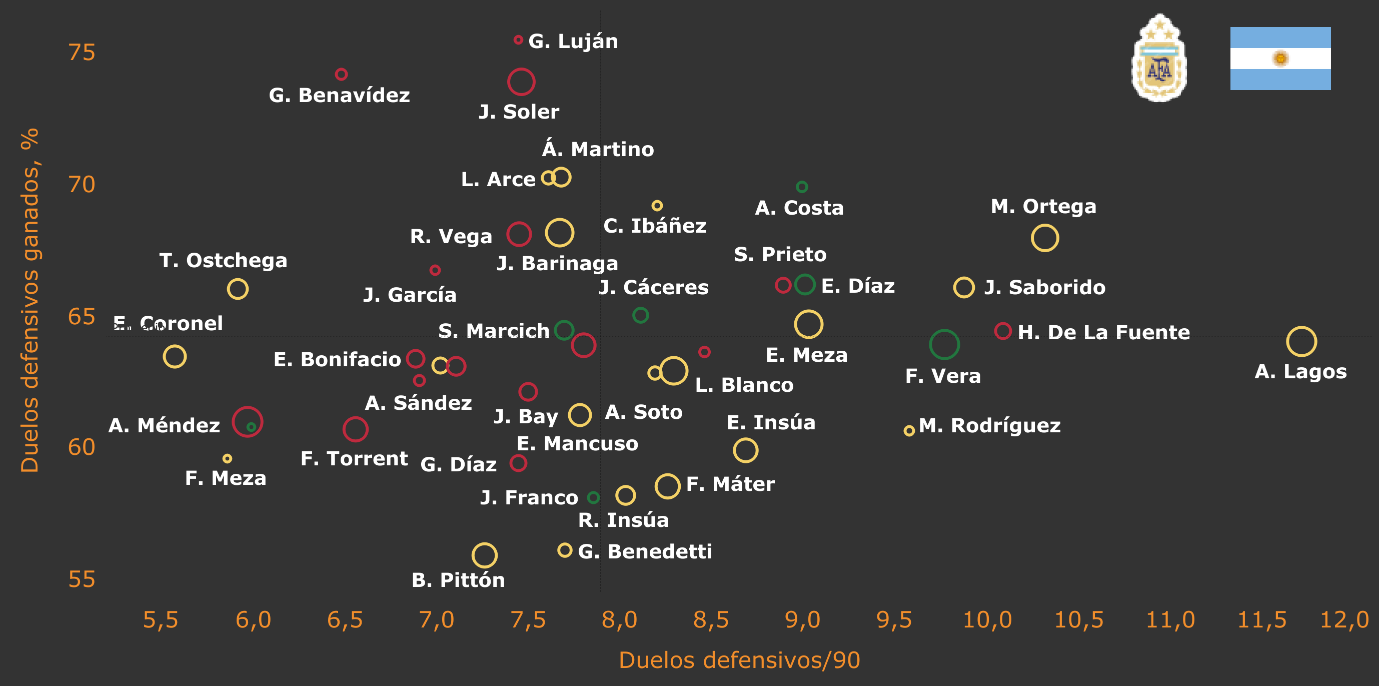
Let's begin this analysis by considering a single variable: defensive duels. Beyond the names that appear on the graph, we aim to study the players who engage in the most defensive duels with the highest possible effectiveness in a single visualization. The players at the top right of the graph are those who participate in the most duels and have the highest efficiency.

When clubs request a search for a specific position, they define their needs with words, and one must have the skill to translate those words into data. When responding to a specific search, the use of Big Data must adapt to the request. One cannot have a rigid search matrix, as it will not be able to respond to different requests and will instead be trapped in rigid, contextless results. It is reassuring when making a recommendation to have reached the player or players of interest through different search channels and not just by finding that they excel in one particular characteristic.

When the search requires a full-back who "closes the flank" or is defensively solid, we can start by examining their defensive behavior. Initially, we must define our filters for the search. For the cases we will analyze later, these filters will be players who have played more than 600 minutes, with more than 55% efficiency in defensive duels, and an average of 3 interceptions per match.

Texto

Descripción generada automáticamente con confianza media


In this graph, in addition to seeing the number of duels and their efficiency in the defensive area, we also see circles and colors. The color of the circles indicates the number of fouls committed: green is the highest scale, yellow is intermediate, and red is the lowest scale. The size of the circles indicates successful attacking actions. The larger the circle, the greater the participation.

Thus, in a simple visualization, we can relate four factors: average defensive duels per 90 minutes + defensive duel efficiency % + average fouls committed per 90 minutes + average successful attacking actions per 90 minutes.

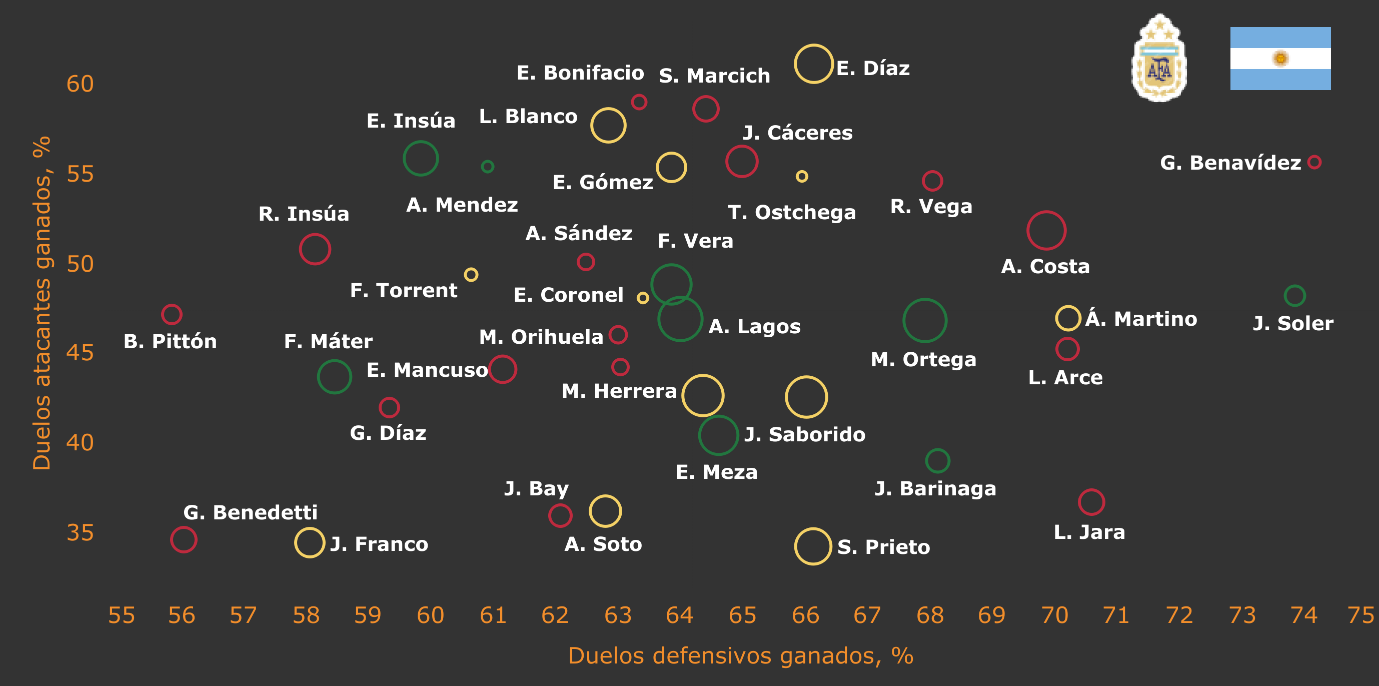
From another perspective, we will now try to get a broader view of the performance, both offensive and defensive, of the full-backs in Argentine football. Therefore, we analyze in this graph the efficiency of the players in attack and defense, linking the effectiveness of these aspects.

Imagen que contiene Interfaz de usuario gráfica

Descripción generada automáticamente


Players positioned further to the right have higher defensive effectiveness, and those positioned higher have greater offensive effectiveness. The ideal case is to be at the top right, as it fulfills both functions. The color of the circles indicates the average number of offensive duels per match: green is the highest scale, yellow is intermediate, and red is the lowest scale. The size of the circles indicates the average number of defensive duels per match. The larger the circle, the greater the participation.

In this visualization, we again see four related variables. On one side, we see a graph that defines efficiency in attack and defense. On the other, through the colors and sizes of the circles, we see if this efficiency also translates into the number of participations. Efficiency is different for a player who engages in few duels compared to one who engages in many. Another important factor is whether these performance data are achieved by the player playing more than 60 minutes or coming off the bench for a handful of minutes.

One of the most common mistakes in Big Data occurs when a player contributes coming off the bench. The system extrapolates what was done in the minutes played, assuming that the same can be achieved over 90 minutes. A player's intensity is not the same throughout the entire match, so this is a point to be especially careful about.

To conclude, Big Data has infinite possibilities and millions of possible combinations. Just as not all musicians write the same song, not all data analysts reach the same players. It is important to highlight the skill of the person conducting the search as a means to obtain a result that meets the pre-established objectives.

By Mariano Moroni