Etiquetas

19 junio, 2024

The World of Scouting and Its Context

 Scouting is undoubtedly the quintessential modern tool within professional football structures. Every job has a context that surrounds the activity and imbues it with particularities to consider for its development. The scout's role is no exception.

Global Context of Football Scouting

Globalization has transformed the way football clubs search for new players to recruit. They no longer limit themselves to exploring their region or country but tirelessly search in all corners of the world. The larger the budget, the deeper the club's search. This global quest is partly driven by international competition.

Major European clubs compete not only among themselves but also with teams from other regions of the world, such as South America, North America, and Asia, for standout signings. This intense competition has led to a greater professionalization of the scouting process.

Technological advances have been key in this transformation. Scouts now have access to a wealth of information about players from all over the world. From online databases to live match videos, technology has democratized access to information and allowed for a more thorough evaluation of talent.

Club scouting networks have also evolved. They are no longer limited to local scouts but include talent agents, international collaborators, and partnerships with other clubs. This global collaboration has expanded the reach of clubs in the talent search.

International events such as the World Cup and the UEFA Champions League are important showcases for scouts. These tournaments offer the opportunity to observe the best players in the world in action and evaluate their performance in high-pressure situations.

The increasingly globalized transfer market presents challenges and opportunities. Player movements between leagues and countries are more common, and scouts must be aware of game trends and market dynamics to identify signing opportunities.

However, regulations and restrictions in football can influence club scouting strategies. Limits on foreign player quotas and international transfer rules can restrict clubs' ability to sign certain players from different regions.

Today, the global context of football scouting is dynamic and highly competitive. Technological advances, international competition, and a globalized transfer market have transformed the way clubs seek talent worldwide, creating a context where the challenge is to find the ideal player before others do and to know them better than the competition.


Scouting in South America: A Unique Perspective

Scouting in South America presents particular characteristics that make it unique compared to other regions of the world. It is marked by a rich football tradition, a wide diversity of talents, high-level competitions, and economic challenges. Scouts operating in South America must be attentive to these unique features while seeking to identify players.

The South American region has produced numerous world-class talents over the years. Countries like Brazil, Argentina, Uruguay, and Colombia have a long and rich football tradition, with a culture deeply rooted in the sport. This football tradition is the result of decades of passion and dedication to the game.

Additionally, the diversity of talent in South America is another unique characteristic. From skilled forwards to solid defenders, modern fast wingers, and midfielders with remarkable athletic abilities, the region is an inexhaustible source of talent in all positions. This diversity of playing styles makes scouting in South America exciting and challenging at the same time.

Many South American countries have a wide network of academies and football schools that nurture and develop young talents from an early age. These institutions are often the first stop for scouts when their objectives focus on finding future stars. In the case of these potential figures, youth scouting in South America is closely tied to their national team competitions since they do not have international club tournaments throughout the season as in Europe. Therefore, CONMEBOL youth tournaments are very special in this world.

High-level competition in tournaments such as the Copa Libertadores and the Copa Sudamericana also offers a platform to observe players of any age in elite competitive situations. The high demand for these prestigious and traditional competitions provides scouts with a context and platform to observe players in high-level competitive situations.

Despite exporting numerous talents to European football, South America has developed a stronger and more competitive internal market in recent decades, with significant players in the region such as Brazilian clubs. This means that South American clubs when trying to sign players, not only compete with Europe but also with some giants from their continent. Added to this are new "big fish" from other regions, such as Asia, and leagues that, due to their socioeconomic context, attract interest from players, like MLS.

This also means that many South American clubs face economic challenges that limit their ability to retain their best players and develop more robust scouting infrastructures. Despite the abundant talent, the lack of resources can hinder clubs' ability to identify and acquire talent but does not make it impossible. Today, even clubs outside the top divisions are creating structures tailored to their realities to take advantage of the scouting tool.

South America is marked by a rich football tradition, an incredible array of players, a wide diversity of talents or styles, and socioeconomic challenges unique to the region, making this job in our region a lovely challenge and an exciting task.
By Ivan Ortíz

El mundo del scouting y su contexto

 El scouting es, sin dudas, la herramienta moderna por excelencia dentro de las estructuras profesionales dedicadas al fútbol. Dentro de cada labor hay un contexto que rodea la actividad y la tiñe de particularidades a tener cuenta, para su desarrollo. La del scout no es la excepción.

Contexto Global del Scouting en el Fútbol

La globalización ha transformado la manera en que los clubes de fútbol buscan perfiles a incorporar. Ya no se limitan a explorar su región o país de origen, sino que buscan incansablemente en todos los rincones, y a mayor presupuesto es más profunda la búsqueda de los clubes. Esta búsqueda global se debe, en parte, a la competencia internacional.

Grandes clubes europeos compiten no solo entre sí, sino también con equipos de otras regiones del mundo, como América del Sur, Norteamérica y Asia, por fichajes destacados. Esta intensa competencia ha llevado a una mayor profesionalización del proceso de scouting.

Los avances tecnológicos han sido clave en esta transformación. Los scouts ahora acceden a mucha información sobre jugadores de todas partes del mundo. Desde bases de datos en línea hasta videos de partidos en vivo, la tecnología ha democratizado el acceso a la información y ha permitido una evaluación más exhaustiva del talento.

Las redes de scouting de los clubes también han evolucionado. No se limitan a scouts locales, sino que incluyen agentes de talento, colaboradores internacionales y acuerdos de colaboración con otros clubes. Esta colaboración global ha ampliado el alcance de los clubes en la búsqueda de talento.

Eventos internacionales como la Copa del Mundo y la UEFA Champions League son vitrinas importantes para los scouts. Estos torneos ofrecen la oportunidad de observar a los mejores jugadores del mundo en acción y evaluar su rendimiento en situaciones de alta presión.

El mercado de fichajes, cada vez más globalizado, presenta desafíos y oportunidades. Los movimientos de jugadores entre ligas y países son cada vez más comunes, y los scouts deben estar al tanto de las tendencias del juego, y a su vez del mercado, para identificar oportunidades de fichaje.

Sin embargo, las regulaciones y restricciones en el fútbol pueden influir en las estrategias de scouting de los clubes. Los límites de cupos de extranjeros y las normativas de traspasos internacionales pueden limitar la capacidad de los clubes para fichar ciertos jugadores, de regiones distintas a la suya.

Hoy, el contexto mundial del scouting en el fútbol es dinámico y altamente competitivo. Los avances tecnológicos, la competencia internacional y el mercado de fichajes globalizado han transformado la manera en que los clubes buscan talento en todo el mundo, creando un contexto en el cual el reto es conseguir al jugador ideal antes que los demás y conocerlo más que la competencia.


El Scouting en Sudamérica: Una Perspectiva Única

El scouting en Sudamérica presenta características particulares que lo hacen único en comparación con otras regiones del mundo, está marcado por una rica tradición futbolística, una amplia diversidad de talentos, competencias de alto nivel y desafíos económicos. Los scouts que operan en Sudamérica deben estar atentos a estas características únicas mientras buscan identificar jugadores.

La región sudamericana ha producido numerosos talentos de clase mundial a lo largo de los años. Países como Brasil, Argentina, Uruguay y Colombia tienen una larga y rica tradición en el fútbol, con una cultura arraigada en el deporte. Esta tradición futbolística es el resultado de décadas de pasión y dedicación al juego.

A su vez, la diversidad de talentos en Sudamérica es otra característica única. Desde habilidosos delanteros hasta sólidos defensores, pasando por los modernos extremos veloces y mediocampistas con capacidades atléticas notables, la región es una fuente inagotable de talento en todas las posiciones. Esta diversidad de estilos de juego hace que el scouting en Sudamérica sea emocionante y desafiante al mismo tiempo.

Muchos países sudamericanos cuentan con una amplia red de academias y escuelas de fútbol que nutren y desarrollan jóvenes talentos desde una edad temprana. Estas instituciones son a menudo la primera parada para los scouts, cuando sus objetivos se basan en la búsqueda de futuras estrellas. En el caso de estas potenciales figuras, el scout de jóvenes en Sudamérica va muy atado a sus competiciones juveniles a nivel de selección, al no contar con torneos internacionales de clubes durante toda la temporada, como pasa en Europa. Por eso los torneos CONMEBOL de categorías juveniles son tan especiales en este mundo.

La competencia de alto nivel en torneos como la Copa Libertadores y la Copa Sudamericana también ofrece una plataforma para observar a jugadores, de cualquier edad, en situaciones competitivas de élite. La exigencia alta de estas prestigiosas y tradicionales competencia, nos ofrecen a los scouts un contexto y una plataforma para observar a jugadores en situaciones competitivas de alto nivel.

A pesar de exportar numerosos talentos al fútbol europeo, Sudamérica ha desarrollado un mercado interno más fuerte y competitivo en las últimas décadas, con actores de peso en la región como los clubes de Brasil. Esto significa que los clubes sudamericanos, al intentar contratar, ya no solo compiten con Europa, sino que con algunos gigantes de nuestro mismo continente. A lo que se le suman nuevos “peces gordos” de otras regiones, como Asia, y ligas que por su contexto socioeconómico levantan el interés en jugadores, como la MLS.

Esto acompaña a que muchos clubes sudamericanos enfrentan desafíos económicos que limitan su capacidad para retener a sus mejores jugadores y desarrollar infraestructuras de scouting más sólidas. A pesar del talento abundante, la falta de recursos puede dificultar la identificación y adquisición de talento por parte de los clubes, pero no la imposibilita. Hoy ya se ven clubes fuera de las primeras divisiones, creando estructuras ajustadas a sus realidades, para aprovechar la herramienta del scouting.

Sudamérica está marcado por una rica tradición futbolística, un abanico increíble de jugadores, con una amplia diversidad de talentos o estilos, y desafíos socioeconómicos propios de la región, que hace de esta labor en nuestra región un lindo desafío y un reto emocionante. 

Por Ivan Ortíz

12 junio, 2024

The Guided Eye

Data can guide the scout's eye to the right place. For this, parameters associated with the specific search need must be used. We will address some examples to understand how statistics can help us overcome obstacles, quickly bringing us closer to the available market options that best match our objectives.

The search for a footballer always entails a specific goal. Important data such as playing characteristics, age, biotype, physical attributes, technical qualities, etc., are part of a profile that we must try to match as closely as possible to the selected candidates.

As an example, we will attempt in this article to show the different characteristics of full-backs in Argentina's first division. It is interesting to see how with a simple tool like Tableau and data from Wyscout, we can perform various analyses, focused on different aspects that lead to different conclusions.

In decision-making, it is imperative to broaden the scope of the analysis to consider as many variables as possible, thereby reducing the margin of error. This is why Big Data contributes significantly to the world of scouting by considerably reducing a scarce and irreplaceable factor: working time. In the past, a scout needed to watch 50 players to find 5 of interest; today, thanks to our information, this can be greatly reduced, allowing us to reach players of interest more quickly.

There are two phrases attributed to one of the most famous sports directors that I would like to mention on this occasion. One of them is, "Without data, I don't sign any player; only with data, neither." The other is, "Matches are no longer watched; players within matches are watched." Both phrases refer to the current approach of any football actor, with precise information about practically every player on the planet.

When watching a match, one can learn about the career development of the players on the field. This gives us the chance to confirm or question certain characteristics we already know about the player and observe many others that data cannot provide, such as returning to defensive positions after an attack, emotional situations during a match, etc.

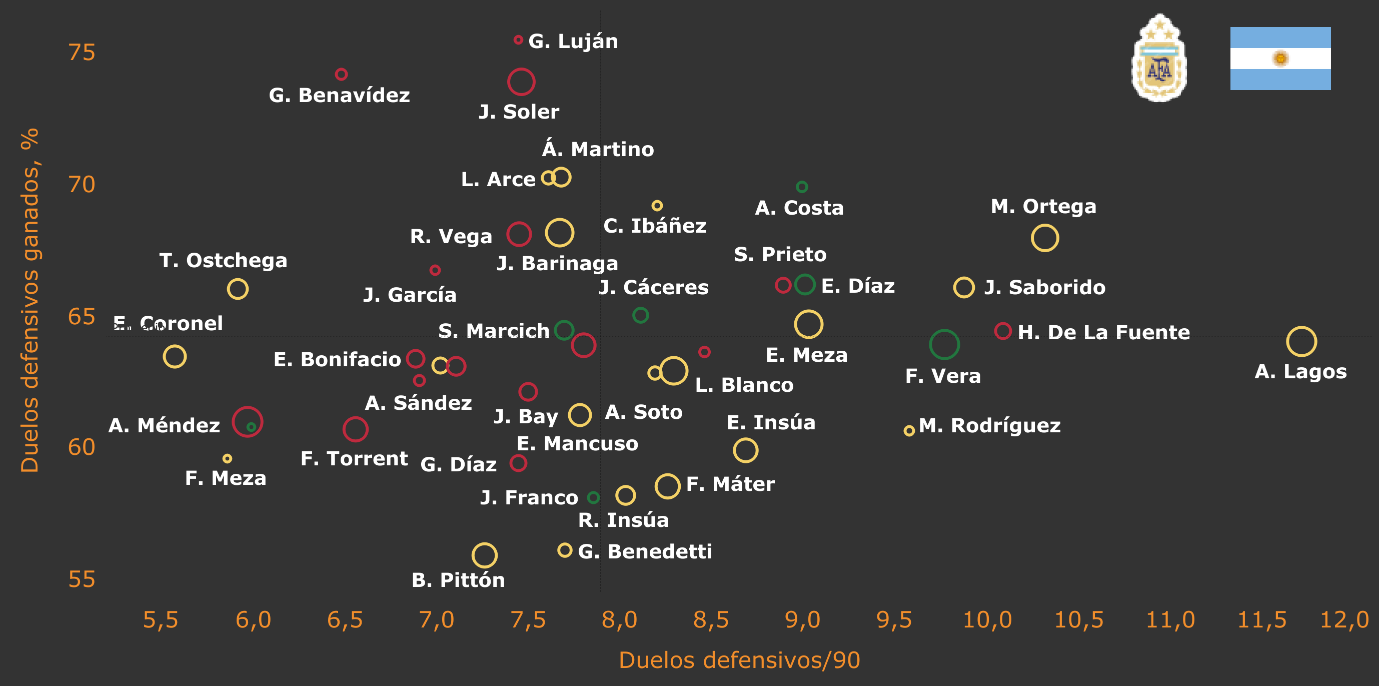
Let's begin this analysis by considering a single variable: defensive duels. Beyond the names that appear on the graph, we aim to study the players who engage in the most defensive duels with the highest possible effectiveness in a single visualization. The players at the top right of the graph are those who participate in the most duels and have the highest efficiency.

When clubs request a search for a specific position, they define their needs with words, and one must have the skill to translate those words into data. When responding to a specific search, the use of Big Data must adapt to the request. One cannot have a rigid search matrix, as it will not be able to respond to different requests and will instead be trapped in rigid, contextless results. It is reassuring when making a recommendation to have reached the player or players of interest through different search channels and not just by finding that they excel in one particular characteristic.

When the search requires a full-back who "closes the flank" or is defensively solid, we can start by examining their defensive behavior. Initially, we must define our filters for the search. For the cases we will analyze later, these filters will be players who have played more than 600 minutes, with more than 55% efficiency in defensive duels, and an average of 3 interceptions per match.

Texto

Descripción generada automáticamente con confianza media


In this graph, in addition to seeing the number of duels and their efficiency in the defensive area, we also see circles and colors. The color of the circles indicates the number of fouls committed: green is the highest scale, yellow is intermediate, and red is the lowest scale. The size of the circles indicates successful attacking actions. The larger the circle, the greater the participation.

Thus, in a simple visualization, we can relate four factors: average defensive duels per 90 minutes + defensive duel efficiency % + average fouls committed per 90 minutes + average successful attacking actions per 90 minutes.

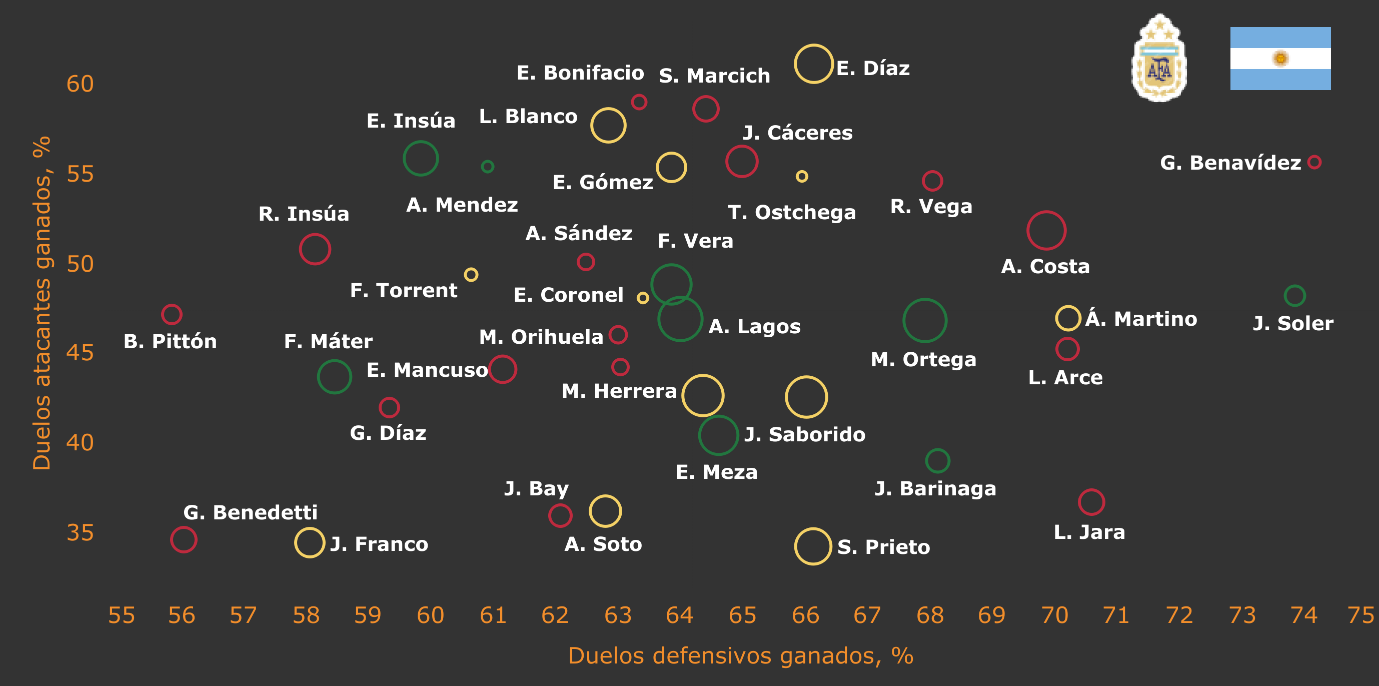
From another perspective, we will now try to get a broader view of the performance, both offensive and defensive, of the full-backs in Argentine football. Therefore, we analyze in this graph the efficiency of the players in attack and defense, linking the effectiveness of these aspects.

Imagen que contiene Interfaz de usuario gráfica

Descripción generada automáticamente


Players positioned further to the right have higher defensive effectiveness, and those positioned higher have greater offensive effectiveness. The ideal case is to be at the top right, as it fulfills both functions. The color of the circles indicates the average number of offensive duels per match: green is the highest scale, yellow is intermediate, and red is the lowest scale. The size of the circles indicates the average number of defensive duels per match. The larger the circle, the greater the participation.

In this visualization, we again see four related variables. On one side, we see a graph that defines efficiency in attack and defense. On the other, through the colors and sizes of the circles, we see if this efficiency also translates into the number of participations. Efficiency is different for a player who engages in few duels compared to one who engages in many. Another important factor is whether these performance data are achieved by the player playing more than 60 minutes or coming off the bench for a handful of minutes.

One of the most common mistakes in Big Data occurs when a player contributes coming off the bench. The system extrapolates what was done in the minutes played, assuming that the same can be achieved over 90 minutes. A player's intensity is not the same throughout the entire match, so this is a point to be especially careful about.

To conclude, Big Data has infinite possibilities and millions of possible combinations. Just as not all musicians write the same song, not all data analysts reach the same players. It is important to highlight the skill of the person conducting the search as a means to obtain a result that meets the pre-established objectives.

By Mariano Moroni

El Ojo Guiado

 Los datos pueden guiar la vista del ojeador hacia el lugar correcto. Para ello se deben utilizar parámetros asociados a la necesidad puntual de búsqueda. Abordaremos algunos ejemplos que permitan comprender desde qué lugar las estadísticas nos pueden ayudar a sortear obstáculos, acercándonos rápidamente a las opciones de mercado disponibles más cercanas a nuestro objetivo.

La búsqueda de un futbolista siempre lleva aparejado un objetivo puntual. Datos importantes como las características de juego, la edad, el biotipo, físico, las cualidades técnicas, etc, son parte de un perfil al que debemos tratar de acercar en la mayor medida posible a los candidatos seleccionados. 

A modo de ejemplo, intentaremos en este artículo mostrar las distintas características de los laterales de la primera división de la Argentina. Es interesante ver cómo con una herramienta sencilla como Tableau y los datos de Wyscout, podemos realizar distintos análisis, enfocados en diversos aspectos que determinan conclusiones diferentes. 

En la toma de decisión es imperioso ampliar la visión del análisis para poder tener en cuenta la mayor cantidad de variables posibles y así disminuir el margen de error. Es por eso que el Big Data viene a aportar al mundo del scouting la reducción considerable de un  factor que es escaso e irrecuperable: los tiempos de trabajo. En otro tiempo un scout precisaba ver 50 jugadores para que 5 sean de interés, hoy gracias a la información con la que contamos, esto se puede reducir enormemente y llegar a jugadores de interés más rápido.

Hay dos frases que se le adjudican a uno de los más famosos directores deportivos que me gustaría mencionar en esta ocasión. Una de ellas es “sin los datos no contrato ningún jugador, solo con los datos tampoco”. La otra es “ya no se miran partidos, se miran jugadores dentro de partidos”. Ambas frases están referidas al acercamiento que hoy en día tiene cualquier actor del fútbol, con la información precisa de, prácticamente, todos los jugadores del planeta. 

Al observar un partido, se puede conocer el desarrollo de carrera de los jugadores presentes en el juego. Esto nos da la chance de confirmar u objetar ciertas características que ya conocemos del jugador y observar otras tantas que el dato no nos puede proveer como puede ser el regreso a posiciones defensivas después de un ataque o situaciones anímicas durante un partido, etc etc. 

Iniciemos este análisis contemplando una sola variable: duelos defensivos. Más allá de los nombres que aparecen en el gráfico, lo que intentamos estudiar en una solo visualización son los jugadores que mayor cantidad de duelos defensivos disputan con la mayor efectividad posible. Los jugadores que estén arriba a la derecha del gráfico son los que más duelos disputan y mayor eficiencia tienen. 

Los clubes cuando solicitan una búsqueda para una posición en particular definen lo que precisan con palabras y uno debe tener la pericia de transformar esas palabras en datos. El uso del Big Data, al responder a una búsqueda en particular, debe adaptarse a lo solicitado. Uno no puede tener una matriz rígida de búsqueda ya que no va a poder responder a distintos pedidos, sino más bien va a quedar atrapado en resultados rígidos sin contexto. Es un reaseguro a la hora de hacer una recomendación, haber llegado al jugador o los jugadores de interés, por distintos canales de búsqueda y no por encontrar que destaca en alguna u otra característica en particular.

Cuando la búsqueda nos pide un lateral que “cierre la banda” o que defensivamente sea sólido, podemos empezar por mirar cómo se comporta defensivamente. Inicialmente debemos definir nuestros filtros para buscar, para los casos que analizaremos después, serán jugadores que jugaron más de 600 minutos jugados, con más de 55 % de eficiencia en duelos defensivos y un promedio de 3 intercepciones por partido.

Texto

Descripción generada automáticamente con confianza media


En este gráfico además de ver la cantidad de duelos disputados y su eficiencia en el rubro defensivo también vemos círculos y colores. El color de los círculos define la cantidad de faltas realizadas, el color verde es la escala mayor, amarillo intermedio y rojo es la menor escala. El tamaño de los círculos define las acciones de ataque exitosas. Cuanto más grande es el círculo mayor es la participación.

Entonces en una simple visualización podemos relacionar 4 factores, cantidad de duelos defensivos promedio/90 + Eficiencia en duelos defensivos % + Faltas cometidas promedio/90 + Acciones de ataque exitosas promedio/90.

En otro enfoque ahora intentaremos obtener una visión más amplia de la performance, tanto ofensiva como defensiva, de los laterales del futbol argentino. Por eso analizamos en este gráfico la eficiencia de los jugadores en ataque y en defensa vinculando la efectividad de estos aspectos.

Imagen que contiene Interfaz de usuario gráfica

Descripción generada automáticamente

Los jugadores que estén situados más a la derecha serán los que tienen mayor efectividad defensiva, los que estén más alto serán los que tienen mayor efectividad ofensiva. El mejor caso es estar arriba a la derecha ya que cumple las dos funciones. El color de los círculos define la cantidad de duelos ofensivos promedio por partido, el color verde es la escala mayor, amarillo intermedio y rojo es la menor escala. El tamaño de los círculos define la cantidad de duelos defensivos disputados promedio por partido. Cuanto más grande es el círculo mayor es la participación.

En esta visualización vemos otra vez 4 variables que relacionamos, por un lado, vemos un gráfico que define la eficiencia en ataque y defensa. Por el otro, a través de los colores y el tamaño de los círculos, vemos si esta eficiencia también se traduce en cantidad de participaciones. No es lo mismo la eficiencia para un jugador que disputa pocos duelos que la de uno que realiza muchos. Otro factor importante es si estos datos de performance el jugador los consigue jugando más de 60 minutos o entrando un puñado de minutos desde el banco.

Uno de los errores más comunes en el Big Data se da cuando el jugador realiza su aporte entrando desde el banco. El sistema extrapola lo realizado en los minutos que ingreso suponiendo que lo mismo lo puede efectuar en 90 minutos. La intensidad de un jugador no es la misma todo el partido por eso es un punto para tener especial cuidado.

Para concluir, el Big Data tiene infinitas posibilidades y millones de combinaciones posibles. Así como todos los músicos no escriben la misma canción, no todos los analistas de datos llegan a los mismos jugadores y es importante destacar la pericia del que realiza la búsqueda como medio para obtener un resultado adecuado a los objetivos preestablecidos.

Por Mariano Moroni

11 junio, 2024

The Relative Age Effect in Football

 In the world of football, where passion and skill intertwine in every play, there exists a less visible but equally crucial backdrop: the way emerging talent is identified and nurtured. In this universe of competition and selection, where each young aspirant seeks their chance to shine amidst the crowd, an intriguing and often fleeting phenomenon has been quietly operating, influencing the fate of countless future stars. This phenomenon, known as the Relative Age Effect (RAE), emerges as one of those underlying forces that shape the path to success in football, where the date of birth can be a determining factor.

On training grounds and playing fields around the world, the RAE weaves its subtle yet powerful web, altering the course of young talents' careers before they even realize it. From selection processes in youth academies to recruitment decisions in professional teams, this phenomenon exerts a discreet but significant influence, shaping the destiny of those who dream of making their mark in the football world. It is a phenomenon that deserves attention and reflection, as it challenges our conventional notions of fairness and equity in sport, posing incisive questions about how we can ensure a level playing field for all aspirants, regardless of their birth date.


The Roots of the Relative Age Effect (RAE):

The RAE manifests in youth football in two main ways. Firstly, players born in the second half of the selection period often need help to compete with those born in the first months of the category. This early disadvantage can demoralize young talents, leading them to abandon the sport before they have the chance to show their true potential.

Secondly, scouts, tasked with discovering the next rough diamonds, may overlook players who seem less physically developed, without realizing or detecting that their technical and tactical ability may be just as promising. Thus, the RAE not only biases opportunities for young players but also distorts the perception of genuine talent.

Let's take the example of youth academy selections in top-level clubs or even neighborhood grassroots schools. Often, players born in the last months of the school year (according to the Argentine calendar) are more likely to be selected due to their greater physical maturity, creating a cycle where the age advantage overshadows the cognitive and technical skills of young talents.

The numbers don't lie: studies in South America have shown an overrepresentation of older children in youth teams, while those born in the early months of the year are significantly underrepresented. The same happens in European countries despite the calendar being organized differently. This gap in representation suggests a selection system that prioritizes age over true talent, creating an uneven playing field from an early age.

This can trigger a domino effect: The implications of the RAE transcend the playing field, infiltrating the coaching and development world. Coaches, unaware, may invest more time and resources in older players, perceived as more competent from the start, perpetuating a cycle of inequality that persists into adolescence and beyond.

Courting Talent: the Mistake of Judging Prospects:

Scouts, when evaluating local and national youth leagues, can fall into the trap of prioritizing physical performance over technical and tactical skills. The RAE distorts the perception of talent as we've already mentioned, letting promising young players slip through simply because they don't fit the expected physical mold.

Reforming selection and development processes is the first step to counteracting the negative impact of the Relative Age Effect. Clubs can focus on more comprehensive evaluation systems that value long-term potential and skills over immediate performance. Additionally, adjusting the recruitment age can mitigate these differences, creating a more equitable environment for youth growth.

The future of football depends on our ability to free it from the chains of age bias and prioritize true talent over physical maturation. Only then can we celebrate the most genuine victories, where each player is recognized for their skill, not the moment they were born. In a sport that transcends borders and cultures, it is essential to maintain justice and equity as fundamental pillars, ensuring that football remains a game for everyone, regardless of the season they were born in.

By Calvin Dannwolf